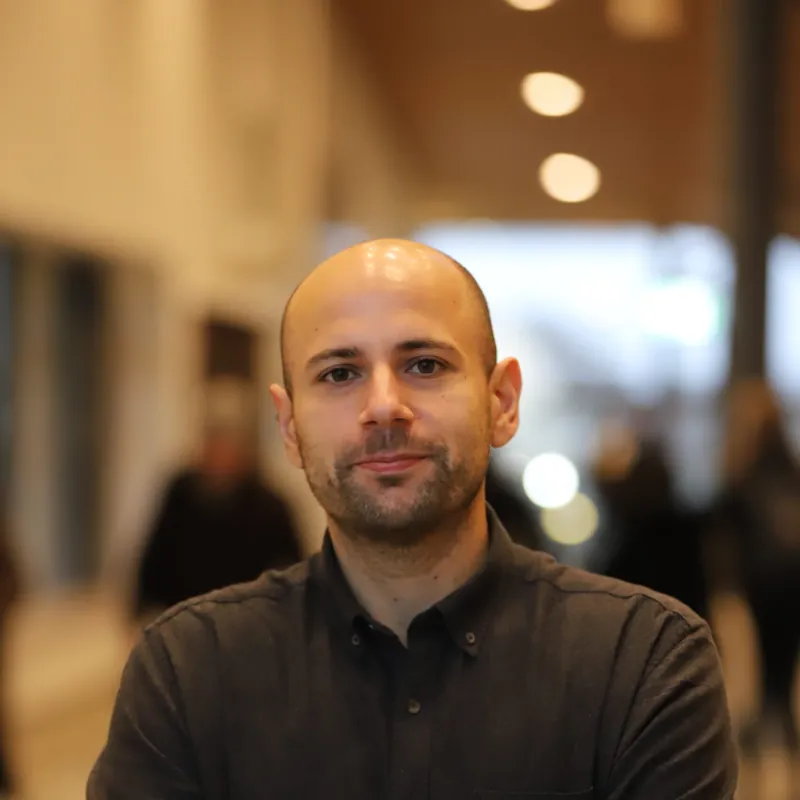
Featured member, November 2026: Leonardo Olivetti

Hi Leonardo! Could you tell us a bit about yourself and your work?
I am an applied statistician interested in a wide range of applications related to climate, health and economics. I am currently in the final stages of my PhD at Uppsala University, planning to defend my thesis in January 2027. My research has mainly focused on the evaluation and methodological development of large-scale AI weather models for medium-range forecasting, particularly in relation to weather extremes. By now, we know that these models can outperform physics-based models in terms of standard evaluation metrics. But do they really work when it matters most, as in the case of extreme weather events? And do improvements in standard meteorological metrics translate into better predictions of impacts and greater economic value?
I am also very interested in ethical questions surrounding the adoption of AI weather models and AI more generally. Current developments in AI weather forecasting are largely driven by major technology companies and meteorological institutions predominantly based in wealthier parts of the world, against a backdrop of pre-existing inequalities in knowledge generation in climate science and natural hazards research. Moreover, smaller and less economically developed countries tend to be more reliant on large-scale weather models, as they have fewer resources to develop their own high-resolution regional models. Some fundamental questions are therefore: Who benefits most from the forecasting improvements brought about by AI weather models? What unintended consequences might an increasing reliance on these models have for countries that are not actively involved in their development? And how can we ensure that deliberate modelling choices, rather than chance or poorly understood aspects of the models, determine how forecasting improvements are distributed?
Alongside my main PhD project, I have worked on several projects related to climate and health, particularly on the cumulative effects of exposure to heat and cold on mortality, hospitalisations, and various cardiovascular outcomes, and on how recent advances in machine learning architectures may help improve existing models. I am particularly interested in the methodological development of models in environmental epidemiology and in how to better link them with large-scale weather models.
What kinds of research opportunities or collaborations are you excited to be part of in the future?
I am open to a wide range of projects involving quantitative methods in climate science, weather forecasting, epidemiology, economics and ethics – I easily get excited about new statistical methods and applications! That said, I strive to spend most of my working time on projects with clear real-world applications, addressing relevant societal or ethical questions with the potential to make a positive difference in someone’s life. If you have any ideas along these lines, big or small, hit me up!
Is there anything else you would like to share with the Climate AI Nordics network?
I think Climate AI Nordics is a great initiative, and I would love to connect with more people who are passionate about tackling some of these questions!
What is the best way for people to get in touch with you?
You can reach me either via LinkedIn or by email at leonardo.olivetti@geo.uu.se.