
Featured member, April 2026: Miguel Nobre da Costa
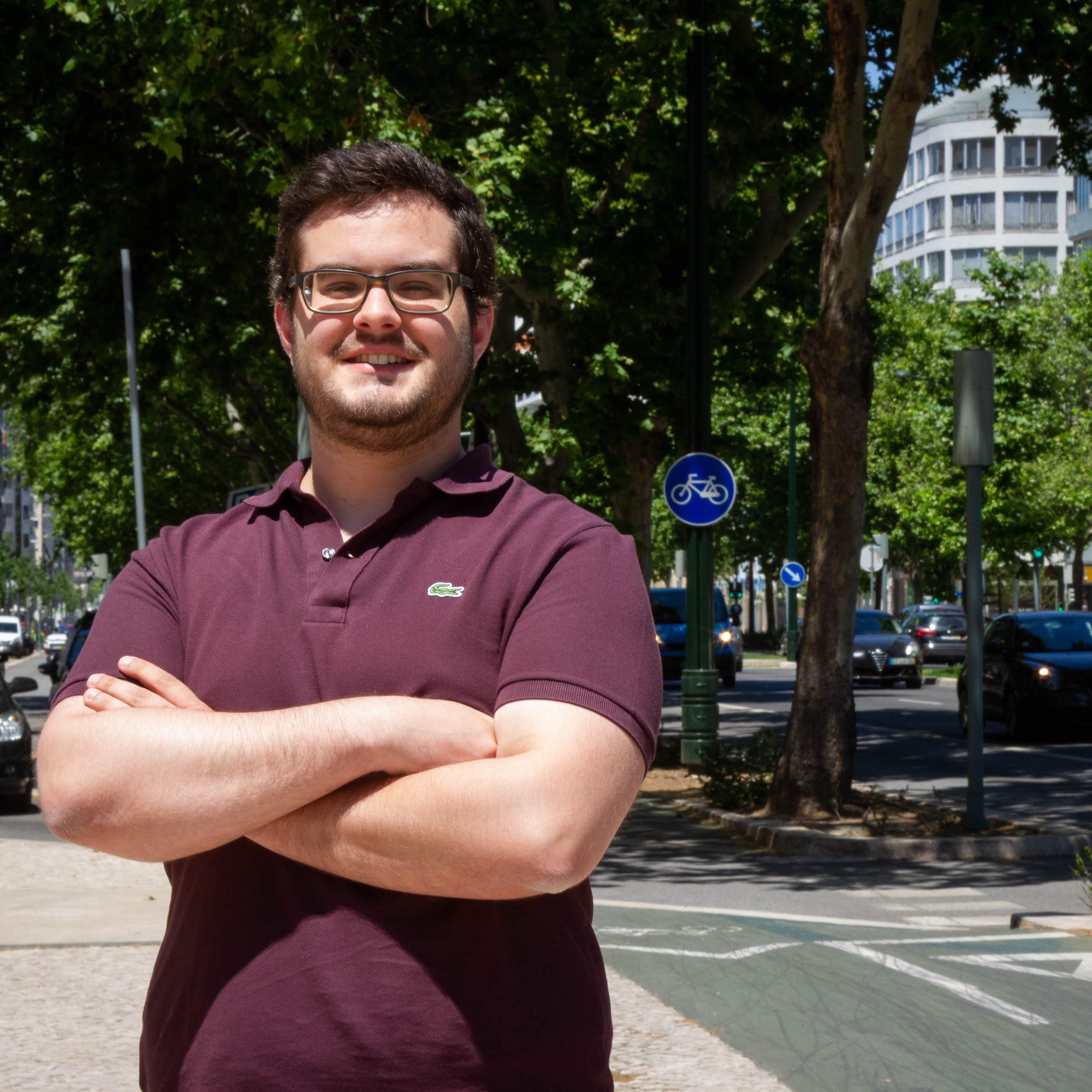
Hi Miguel! Could you tell us a bit about yourself and your work?
I am a postdoc at the Technical University of Denmark (DTU), where I develop an AI-based decision support tool for climate adaptation as part of the MA’AT project (MAximizing wellbeing with AI under deep climate Turmoil).
Our framework adopts a system-of-systems approach, combining climate, transport, and wellbeing modeling with reinforcement learning. The goal is to identify transport-related adaptation pathways that minimize climate change impacts on transportation and, consequently, on people’s wellbeing and quality of life.
We apply this framework to rain and pluvial flooding events (ranging from nuisance flooding to extreme events) in the Copenhagen capital region. Early results demonstrate the potential of reinforcement learning as a flexible decision-support tool for adaptive infrastructure planning under climate uncertainty, successfully balancing complex trade-offs between impact reduction and adaptation investment.
My background and interests lie at the intersection of AI and transport, spanning urban mobility, road safety, geospatial analytics, urban form, and the gap between objective metrics and human perceptions. More broadly, I’m interested in how AI can empower human decision-makers to navigate complex interactions and uncertain futures to make our cities safer, more livable, and sustainable.
What kinds of research opportunities or collaborations are you excited to be part of in the future?
The challenges we address in MA’AT are inherently transboundary: heatwaves, cloudbursts, flooding, and sea-level rise affect cities worldwide, while cascading risks impact mobility, access to essential services, energy, housing, and equity under political and budgetary constraints. I’m excited to expand our framework’s scope by incorporating new climate stressors, expanding the simulation domain, and assessing additional impact dimensions.
There are also compelling AI and computational opportunities to explore, including multi-agent and surrogate-assisted reinforcement learning, visualization and interpretation of adaptation pathways and tipping points, intervention-consistent causal models, and transfer learning to other contexts and domains.
Looking ahead, I’m working toward an assistant professor position at the intersection of urban and transport science, and applied AI to support decision-making. I’m particularly interested in interdisciplinary collaborations that bridge climate science, urban and transport planning, computer science, and policy to advance AI-enabled decision support for more resilient, equitable, and livable environments.
Is there anything else you would like to share with the Climate AI Nordics network?
The Nordic region has a unique opportunity to lead in climate-adaptive urban planning. Our cities are compact, data-rich, and face increasingly urgent climate challenges from various stressors. Most importantly, they also recognize that there is a need to adapt now and that data-driven approaches can play a crucial role in both how we adapt and how we communicate that adaptation to stakeholders and the public.
I’m eager to connect with municipalities, research institutions, and companies interested in piloting adaptive planning frameworks or exploring how AI can support long-term resilience strategies. I’m also open to visiting institutions across the Nordics to deliver seminars or workshops on our MA’AT framework and broader applications of reinforcement learning for climate adaptation and urban planning.
What is the best way for people to get in touch with you?
The best way to reach me is via email at migcos@dtu.dk or on LinkedIn. You can also learn more about my research and work on my personal website.
I’m always happy to discuss potential collaborations, research ideas, or opportunities!