
Featured paper: TopoFlow: topography-aware pollutant Flow learning for high-resolution air quality prediction
Authors: Ammar Kheder, Helmi Toropainen, Wenqing Peng, Samuel Antão, Jia Chen, Michael Boy, Zhi-Song Liu
The latest Climate AI Nordics featured paper is”TopoFlow: Topography-Aware Pollutant Flow Learning for High-Resolution Air Quality Prediction”, published in npj Climate and Atmospheric Science.
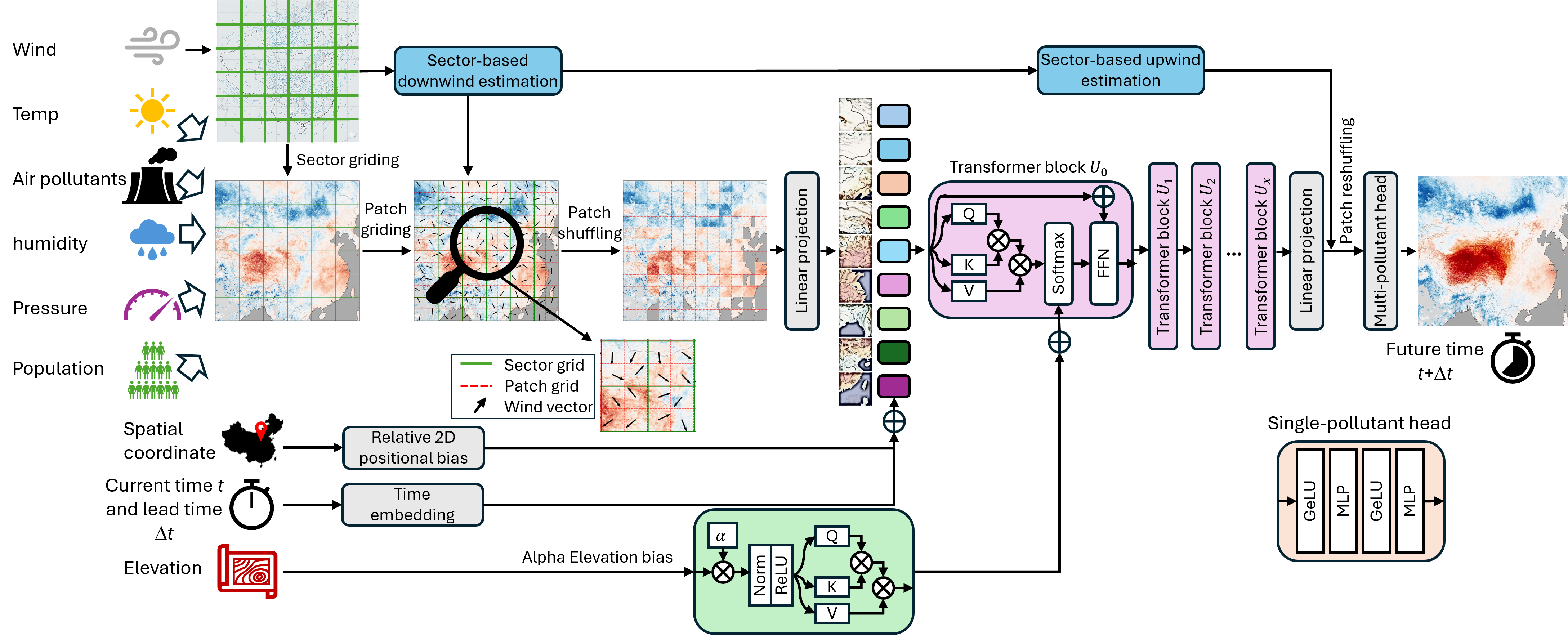
Accurately forecasting air pollution remains challenging, especially in regions with complex terrain where mountains and valleys strongly influence how pollutants move and accumulate. This paper introduces TopoFlow, a physics-guided transformer model that explicitly incorporates two key drivers of pollutant transport: wind direction and topography. Rather than treating these factors as just additional inputs, they are built directly into the model architecture.
Using six years of air quality and weather data across China, TopoFlow achieved state-of-the-art performance, reducing prediction errors by 13% compared to leading AI baselines and by 71-80% compared to operational forecasting systems for PM₂.₅ pollution. The model also demonstrated strong performance across multiple pollutants and forecast horizons up to four days ahead.
Why it matters for climate and the environment: Better air quality forecasts support public health, environmental management, and policy decisions. By bringing physical knowledge directly into AI architectures, TopoFlow highlights how domain-aware machine learning can provide more reliable predictions for complex environmental systems, helping societies respond more effectively to pollution and environmental risks.
For more details, explore: