
Featured Paper: Global fields of daily accumulation-mode particle number concentrations using in situ observations, reanalysis data, and machine learning
Authors: Aino Ovaska, Elio Rauth, Daniel Holmberg, Paulo Artaxo, John Backman, Benjamin Bergmans, Don Collins, Marco Aurélio Franco, Shahzad Gani, Roy M. Harrison, Rakesh K. Hooda, Tareq Hussein, Antti-Pekka Hyvärinen, Kerneels Jaars, Adam Kristensson, Markku Kulmala, Lauri Laakso, Ari Laaksonen, Nikolaos Mihalopoulos, Colin O’Dowd, Jakub Ondracek, Tuukka Petäjä, Kristina Plauškaitė, Mira Pöhlker, Ximeng Qi, Peter Tunved, Ville Vakkari, Alfred Wiedensohler, Kai Puolamäki, Tuomo Nieminen, Veli-Matti Kerminen, Victoria A. Sinclair, and Pauli Paasonen
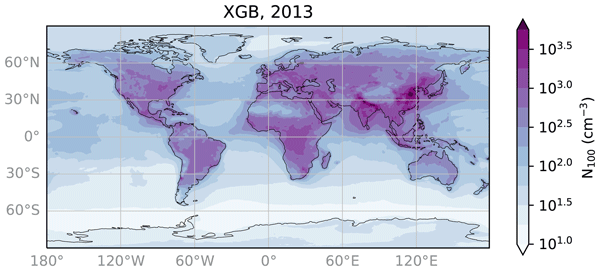
This study presents a machine-learning approach to produce daily global fields of accumulation-mode aerosol particle number concentrations (N100) by combining sparse in situ observations with CAMS reanalysis and ERA5 meteorological data. Multiple linear regression and eXtreme Gradient Boosting models are trained directly on measurements, addressing limitations of satellite retrievals and Earth system models in representing aerosol number concentrations. The models perform well in regions represented in the training data, with more than 70 % of daily estimates within a factor of 1.5 of observations, but show reduced skill in clean and remote environments, underlining the need for broader observational coverage. Aerosol-phase sulfate and gas-phase ammonia concentrations, followed by carbon monoxide and sulfur dioxide emerge as the most influential predictors. The resulting global N100 fields are directly informed by in situ measurements and can be used to study aerosol–cloud interactions and to evaluate climate models.
For more details, explore: