
Featured member, June 2026: Katarzyna Ostapowicz
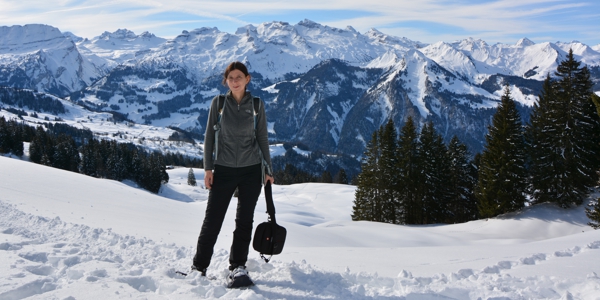
Hi Katarzyna! Could you tell us a bit about yourself and your work?
I am a research scientist specialising in Environmental Data Science and Earth Observation, with a focus on Land System Science, biodiversity and conservation, and climate change. I currently work at the Norwegian Institute for Nature Research (NINA). My research addresses land-use and land-cover dynamics, ecosystem responses to environmental and climatic change, and human–environment interactions. I design and apply spatial modelling frameworks integrating multi-sensor satellite time series, machine learning, and GeoAI to quantify long-term environmental change and climate-driven ecosystem transformations. Much of my work concerns how land systems and ecosystems change under combined climate and human pressures, how these processes unfold across different spatial and temporal scales, and how we can distinguish persistent ecological change from short-term variability. I am particularly interested in how Earth Observation and AI can support sustainability science by providing stronger evidence on landscape change, ecosystem condition, biodiversity pressures, and the outcomes of conservation and restoration actions. This includes the growing need to assess whether nature-based approaches to climate adaptation and land management lead to measurable ecological benefits, rather than only well-intended policy goals. Alongside research, I have led international projects and supervised students at all degree levels.
What kinds of research opportunities or collaborations are you excited to be part of in the future?
I am interested in collaborations that bring together Earth Observation, ecological and climate knowledge, field-based evidence, and advanced spatial modelling to better understand how ecosystems and land systems are changing. I am particularly interested in work on biodiversity change, land-use transitions, restoration outcomes, and the cumulative effects of climate and land-use pressures. I would also be interested in projects that examine when nature-based and land-based responses to climate and biodiversity challenges are effective, under what environmental conditions, and at what spatial scales. In applied environmental science, this requires models that can handle uncertainty, incomplete field data, shifting baselines, and transferability across regions, while still producing evidence useful for conservation, environmental assessment, and land management.
Is there anything else you would like to share with the Climate AI Nordics network?
I see strong value in connecting methodological development with substantive environmental questions. For me, the most interesting use of AI in climate and environmental research is not simply to automate existing analyses, but to help reveal patterns, processes, and emerging risks that are difficult to capture with conventional approaches alone. I would be glad to connect with researchers working at the interface of AI, Earth Observation, ecology, climate change, biodiversity, sustainability science, and applied environmental monitoring.
What is the best way for people to get in touch with you?
The best way to contact me is by email: katarzyna.anna.ostapowicz@gmail.com or katarzyna.ostapowicz@nina.no. I am also available on LinkedIn.